
|
Legal & Tax Disclosure
ATTORNEY ADVERTISING.
This article is provided for general informational purposes only and does not constitute legal, financial, or tax advice. Reading this content does not create an attorney-client or professional advisory relationship. Laws vary by jurisdiction and are subject to change. You should consult a qualified professional regarding your specific circumstances. |
I recently had a client, David, who discovered a decades-old codicil to his mother’s trust – completely unsigned. The trust held significant real estate and brokerage accounts intended for a local animal shelter. Because the codicil wasn’t properly executed, the shelter lost out on a substantial portion of the intended legacy, costing them roughly $180,000 in lost funding for critical programs. This highlights the fragility of even well-intentioned estate plans if the mechanics aren’t flawless.
As an estate planning attorney and CPA with over 35 years of experience here in Corona, California, I frequently advise clients on the best ways to structure charitable trusts. It’s not just about what you give, but how you give it, to maximize the benefit to both the charity and your estate. The unique intersection of tax and estate law, as a CPA, allows me to ensure my clients achieve optimal outcomes, particularly regarding step-up in basis and minimizing capital gains liabilities. Let’s explore the most common assets contributed to these trusts and the considerations involved.
What Types of Assets Are Best Suited for a Charitable Trust?
The flexibility of charitable trusts allows for a wide range of assets, but some are more practical and advantageous than others. Several factors come into play, including liquidity, valuation, and potential tax implications.
Generally, assets that are appreciated or difficult to liquidate often make the most sense. This is because contributing them to a charitable trust can provide an immediate income tax deduction, avoiding capital gains taxes you’d incur if you sold them yourself. Here are some of the most commonly utilized assets:
- Real Estate/Homes: This is a frequent contribution, but requires careful planning. If the property value exceeds the limits for simplified transfer under AB 2016, a Petition will be necessary, requiring a Judge’s Order. To avoid complications, the decedent’s non-real estate assets should typically stay below the $208,850 Small Estate limit. Remember, the rules differ significantly for the Small Estate Affidavit (for property under $69,625).
- Stocks & Bonds: Highly liquid and easily transferred, appreciated securities are prime candidates. You receive a fair market value deduction, avoiding capital gains tax on the appreciation.
- Mutual Funds & ETFs: Similar to stocks and bonds, these offer liquidity and a straightforward valuation for tax purposes.
- Life Insurance Policies: Naming a charitable trust as the beneficiary avoids income tax on the death benefit and can create a substantial gift. The policy’s cash surrender value, if any, is also deductible when transferred to the trust.
How Do Business Interests Factor into Charitable Trusts?
Contributions of business interests, such as LLC membership interests, present unique considerations. The valuation of a privately held business can be complex and requires a qualified appraisal. This is where my CPA background becomes invaluable, ensuring the IRS will accept the valuation. As of March 2025, domestic U.S. LLCs are exempt from mandatory BOI reporting under the Corporate Transparency Act; however, trustees managing foreign-registered entities must still file updates within 30 days to avoid penalties.
What About Less Traditional Assets Like Digital Currency?
The rise of digital assets necessitates specific trust language. Without explicit RUFADAA language (Probate Code § 870) in your trust documents, service providers like Coinbase may legally deny your trustee access to your cryptocurrency holdings. This is a critical oversight many estate plans still lack. We routinely include specific digital asset provisions to address this.
What Happens with Bank Accounts and Cash?
While cash is easily transferred, it may not be the most tax-efficient asset to contribute. If combined ‘probate assets’ (excluding the AB 2016 residence) exceed $208,850 (the threshold effective April 1, 2025), they are subject to formal probate; a Will alone isn’t enough to bypass this limit when funding the Bypass-Trust. Consider using cash to fund the trust alongside more appreciated assets for a balanced approach.
For High-Net-Worth Individuals, How Do Charitable Trusts Interplay with Estate Tax?
For estates approaching the federal estate tax exemption, charitable trusts become even more powerful. The OBBBA permanently increased the Federal Estate Tax Exemption to $15 million per person effective Jan 1, 2026, directly impacting how high-value Bypass-Trusts are shielded from taxation. Strategic use of charitable trusts can significantly reduce estate tax liability. Also, remember that under Prop 19, heirs can only keep a parent’s low property tax base if they move into the home as their primary residence within one year and the home’s value is within specific limits; this is vital to understand when assets are distributed from a Bypass-Trust.
How do California trustee duties and funding rules shape the outcome for beneficiaries?
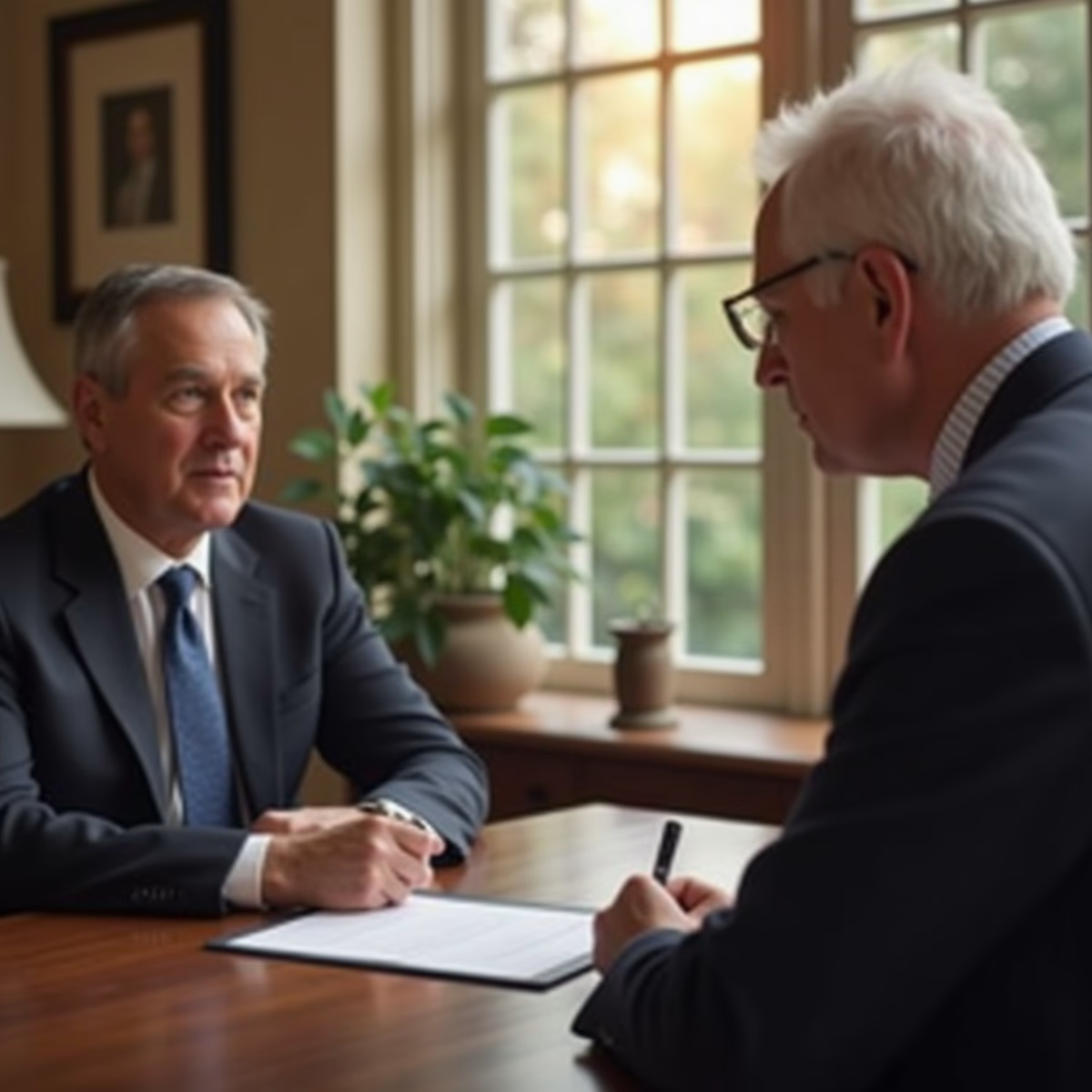
Success in trust administration depends on more than just the document; it requires active management of assets, precise accounting to beneficiaries, and careful navigation of tax rules. Whether dealing with a blended family or complex real estate, understanding the mechanics of trust law is the only way to ensure the grantor’s wishes survive scrutiny.
- Protection: Review asset privacy options.
- Detail: Check testamentary trusts.
- Wealth: Manage long-term trust assets.
A stable trust administration relies on the trustee’s ability to balance investment duties, beneficiary communication, and tax compliance. When these elements are managed proactively, families can avoid the emotional and financial drain of litigation.
Verified Authority on California Bypass Trust Administration
-
Property Tax Reassessment (Prop 19): California State Board of Equalization (Prop 19)
Under Prop 19, heirs can only keep a parent’s low property tax base if they move into the home as their primary residence within one year and the home’s value is within specific limits; this is vital to understand when assets are distributed from a Bypass-Trust. -
Primary Residence Succession (AB 2016): California Probate Code § 13151 (Petition for Succession)
In a Bypass-Trust context, you must distinguish between the Small Estate Affidavit (strictly for real property <$69,625, used for timeshares/vacant land) and AB 2016. For deaths on or after April 1, 2025, a primary residence valued up to $750,000 qualifies for a ‘Petition for Succession’ under AB 2016. This is a “Petition” that requires a Judge’s Order, NOT an “Affidavit.” Note that the decedent’s other non-real estate assets must typically remain below the separate $208,850 Small Estate limit. -
Small Estate Threshold (Bank Accounts/Cash): California Probate Code § 13100 (Personal Property)
If combined “probate assets” (excluding the AB 2016 residence) exceed $208,850 (the threshold effective April 1, 2025), they are subject to formal probate; a Will alone does not allow you to bypass this limit for the purpose of funding the Bypass-Trust. -
Federal Estate Tax (OBBBA): IRS Estate Tax Guidelines
The 2026 “Sunset” was averted by the OBBBA (One Big Beautiful Bill Act), which permanently increased the Federal Estate Tax Exemption to $15 million per person effective Jan 1, 2026, directly impacting how high-value Bypass-Trusts are shielded from taxation. -
Business Interest Compliance (FinCEN): FinCEN – Beneficial Ownership Information (BOI)
As of March 2025, domestic U.S. LLCs are exempt from mandatory BOI reporting under the Corporate Transparency Act; however, trustees managing foreign-registered entities within a Bypass-Trust must still file updates within 30 days to avoid fines of $500/day. -
Digital Asset Access (RUFADAA): California Probate Code § 870 (RUFADAA)
Without specific RUFADAA language (Probate Code § 870) in your Bypass-Trust or Will, service providers like Coinbase and Google can legally deny your trustee access to your digital assets. -
Unclaimed Property Search: California State Controller – Unclaimed Property
The primary portal for trustees to search for “lost” assets—such as forgotten bank accounts or uncashed dividends—that should be funneled into the Bypass-Trust to ensure the full estate tax exemption is utilized.
|
Attorney Advertising, Legal Disclosure & Authorship
ATTORNEY ADVERTISING.
This content is provided for general informational and educational purposes only and does not constitute legal, financial, or tax advice. Under the California Rules of Professional Conduct and State Bar advertising regulations, this material may be considered attorney advertising. Reading this content does not create an attorney-client relationship or any professional advisory relationship. Laws vary by jurisdiction and are subject to change, including recent 2026 developments under California’s AB 2016 and evolving federal estate and reporting requirements. You should consult a qualified attorney or advisor regarding your specific circumstances before taking action.
Responsible Attorney:
Steven F. Bliss, California Attorney (Bar No. 147856).
Local Office:
Corona Probate Law765 N Main St 124 Corona, CA 92878 (951) 582-3800
Corona Probate Law is a practice location and trade name used by Steven F. Bliss, Esq., a California-licensed attorney.
About the Author & Legal Review Process
This article was researched and drafted by the Legal Editorial Team of the Law Firm of Steven F. Bliss, Esq.,
a collective of attorneys, legal writers, and paralegals dedicated to translating complex legal concepts into clear, accurate guidance.
Legal Review:
This content was reviewed and approved by Steven F. Bliss, a California-licensed attorney (Bar No. 147856). Mr. Bliss concentrates his practice in estate planning and estate administration, advising clients on proactive planning strategies and representing fiduciaries in probate and trust administration proceedings when formal court involvement becomes necessary.
With more than 35 years of experience in California estate planning and estate administration,
Mr. Bliss focuses on structuring enforceable estate plans, guiding fiduciaries through court-supervised proceedings, resolving creditor and notice issues, and coordinating asset management to support compliant, timely distributions and reduce fiduciary risk. |