
|
Legal & Tax Disclosure
ATTORNEY ADVERTISING.
This article is provided for general informational purposes only and does not constitute legal, financial, or tax advice. Reading this content does not create an attorney-client or professional advisory relationship. Laws vary by jurisdiction and are subject to change. You should consult a qualified professional regarding your specific circumstances. |
I had a call with Emily last week, and it was a tough one. Her grandfather had established a Dynasty Trust in 2008, carefully designed to benefit three generations. Emily’s mother, a current beneficiary, was attempting to unilaterally change the investment strategy – a strategy the trust had successfully employed for 15 years. When the trustee refused, her mother filed suit, claiming mismanagement. The resulting legal fees? Nearly $80,000, and a fractured family relationship. These disputes are, sadly, far more common than people realize.
What Common Issues Trigger Beneficiary Conflicts?
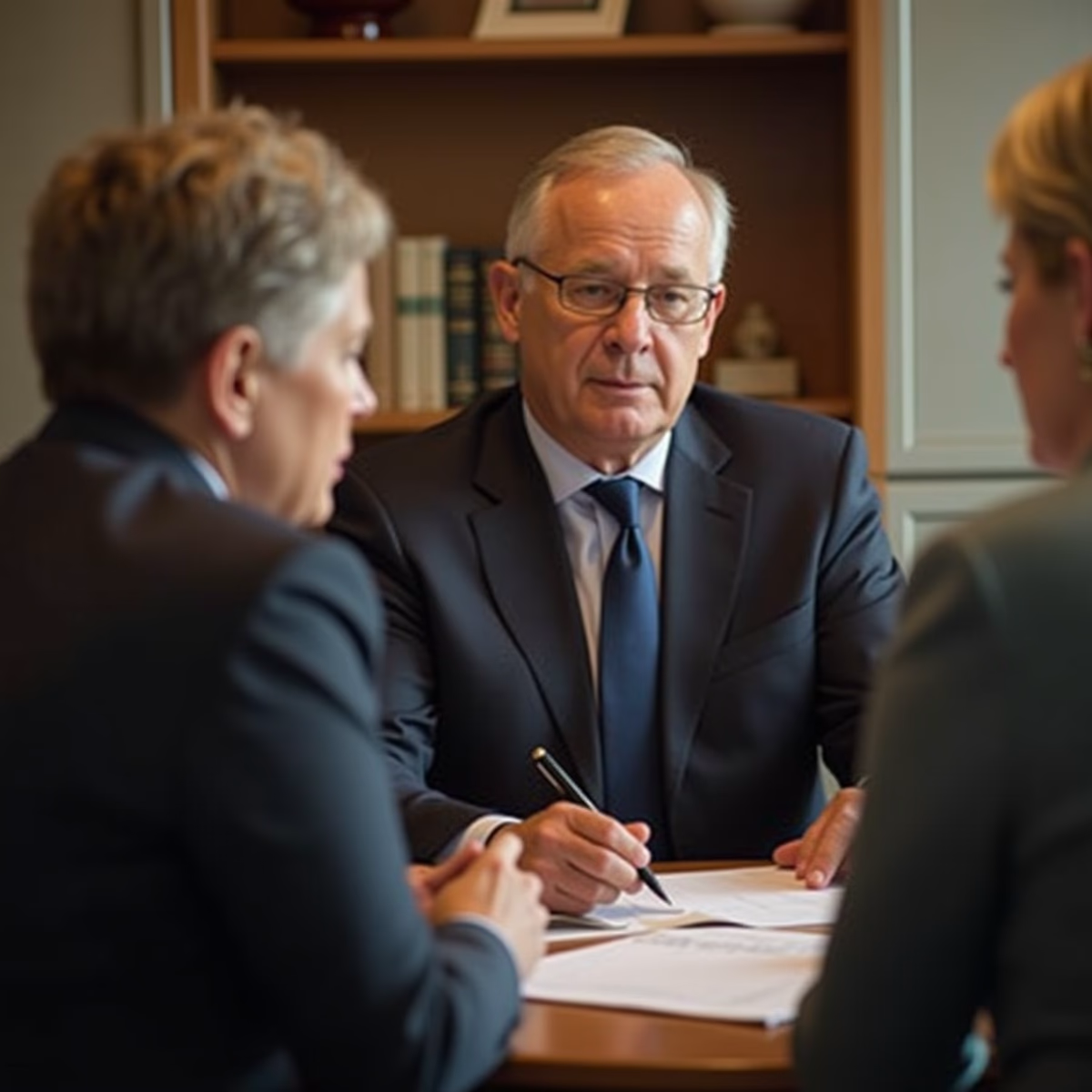
Long-term trusts, by their very nature, are susceptible to disputes. Generations change, priorities shift, and beneficiaries may disagree on the best course of action. Here are some of the most frequent flashpoints I encounter:
- Investment Philosophy: This is the most common source of conflict. Younger beneficiaries might favor riskier, higher-growth investments, while older beneficiaries may prefer more conservative approaches to preserve capital.
- Distribution Requests: Trust documents spell out distribution guidelines, but these can be open to interpretation. A beneficiary might feel entitled to a larger distribution than others, or believe a distribution is being unfairly withheld.
- Trustee Performance: Accusations of mismanagement, self-dealing, or conflicts of interest can quickly escalate into litigation. Even if the trustee is acting within the bounds of the trust document, perceptions matter.
- Changing Life Circumstances: A beneficiary facing unexpected financial hardship might request an early distribution, disrupting the original trust plan.
How Does the Role of the Trustee Impact Disputes?
The trustee plays a pivotal role in mitigating – or exacerbating – these conflicts. A strong, proactive trustee will maintain open communication with all beneficiaries, providing regular updates on trust performance and explaining the rationale behind investment and distribution decisions. However, even with the best intentions, disagreements can arise. It’s crucial for trustees to act impartially and in accordance with the trust document, always prioritizing the long-term interests of the entire beneficiary pool. It’s also important for them to meticulously document all decisions. I’ve seen instances where a trustee’s lack of documentation cost the trust significantly in legal battles.
What Role Does Taxation Play in Beneficiary Disputes?
As both an Estate Planning Attorney and a CPA with over 35 years of experience, I can tell you that taxation is a breeding ground for trust disputes. Beneficiaries often lack a comprehensive understanding of the tax implications of distributions, and decisions made without considering these implications can lead to significant financial penalties. For example, consider the OBBBA (One Big Beautiful Bill Act): effective Jan 1, 2026, the OBBBA set the Federal GST Tax Exemption to $15 million per person; properly allocating this exemption is the only way to shield future generations from an immediate 40% tax on distributions. Without careful planning, a seemingly innocuous distribution could trigger a substantial tax liability that fuels resentment among beneficiaries. Furthermore, the step-up in basis afforded to trust assets at the grantor’s death is often misunderstood, leading to disputes over capital gains taxes when assets are eventually sold.
What Happens When a Beneficiary Challenges a Trust?
When disputes cannot be resolved informally, litigation becomes inevitable. Common legal challenges include claims of breach of fiduciary duty against the trustee, allegations of undue influence in the creation or amendment of the trust, or requests to modify the trust based on changed circumstances. These challenges can be costly and time-consuming, draining trust assets and damaging family relationships. In California, challenging a trust requires a strong legal basis and compelling evidence. A seemingly simple disagreement over a distribution can quickly escalate into a complex legal battle, particularly if the trust is structured as a Dynasty Trust with long-term implications. We recently advised a client contesting a codicil that improperly altered the trust terms – a process that involved detailed valuation of trust assets and expert testimony from a forensic accountant.
Can Dynasty Trusts Be Structured to Reduce Disputes?
Absolutely. Careful drafting is paramount. Here are a few strategies I employ:
- Clearly Defined Distribution Standards: Ambiguous language invites conflict. Specific, objective standards for distributions minimize the potential for disagreements.
- Independent Trustee: Choosing an independent trustee – a professional trust company or attorney – can provide impartiality and expertise.
- Trust Protector: A trust protector provides oversight and can modify the trust terms in response to unforeseen circumstances, offering a built-in mechanism for resolving disputes.
- Regular Beneficiary Meetings: Open communication and transparency foster trust and reduce the likelihood of misunderstandings.
Finally, it’s crucial to understand the rules surrounding trust duration. Unlike many states, California follows the Uniform Statutory Rule Against Perpetuities (USRAP), generally limiting a Dynasty Trust’s existence to 90 years unless specific ‘savings clauses’ or jurisdiction-shifting provisions are drafted. A properly structured trust anticipates these complexities and incorporates provisions to maximize its longevity and minimize the potential for future disputes.
How do California trustee duties and funding rules shape the outcome for beneficiaries?
The advantage of a California trust is control and continuity, but this relies entirely on accurate funding and disciplined administration. Without clear asset titles and strict adherence to fiduciary standards, a private trust can quickly become a subject of public litigation over mismanagement, capacity, or undue influence.
To prevent family friction during administration, trustees must adhere to the rules in trust administration, while beneficiaries should monitor actions to prevent the issues highlighted in trustee errors, ensuring the trusts is enforced correctly.
California trust planning is most effective when the structure is matched to the specific family goal and assets are fully funded into the trust name. When administration is handled with transparency and adherence to the Probate Code, the trust can fulfill its promise of privacy and efficiency.
Verified Authority on California Dynasty Trust Administration
-
Trust Duration Limits (USRAP): California Probate Code § 21205 (90-Year Rule)
The governing statute for the Uniform Statutory Rule Against Perpetuities. Unlike states that allow “forever” trusts, California generally limits a Dynasty Trust’s validity to 90 years, requiring careful drafting to avoid premature termination. -
GST Tax Exemption (OBBBA): IRS Generation-Skipping Transfer Tax
Detailed guidelines reflecting the OBBBA update. Effective January 1, 2026, the GST Tax Exemption is permanently set at $15 million per person, allowing for massive tax-free wealth transfer to grandchildren if allocated correctly. -
Property Tax Reassessment (Prop 19): California State Board of Equalization (Prop 19)
Crucial for Dynasty Trusts holding real estate. Prop 19 severely limits the ability to pass low property tax bases to grandchildren, often triggering reassessment to current market value upon the child’s death. -
Primary Residence Succession (AB 2016): California Probate Code § 13151 (Petition for Succession)
If a residence intended for the trust was accidentally left out, this statute (effective April 1, 2025) allows a “Petition for Succession” for homes valued up to $750,000, avoiding a full probate proceeding. -
Digital Asset Access (RUFADAA): California Probate Code § 870 (RUFADAA)
The authoritative resource on digital assets. Without specific RUFADAA language in the Dynasty Trust, multi-generational access to crypto wallets and digital archives can be legally blocked by service providers. -
Business & LLC Compliance (FinCEN): FinCEN – Beneficial Ownership Information (BOI)
While domestic U.S. LLCs in the trust are now exempt (as of March 2025), trustees managing foreign-registered entities must still comply with strict 30-day reporting windows to avoid federal penalties.
|
Attorney Advertising, Legal Disclosure & Authorship
ATTORNEY ADVERTISING.
This content is provided for general informational and educational purposes only and does not constitute legal, financial, or tax advice. Under the California Rules of Professional Conduct and State Bar advertising regulations, this material may be considered attorney advertising. Reading this content does not create an attorney-client relationship or any professional advisory relationship. Laws vary by jurisdiction and are subject to change, including recent 2026 developments under California’s AB 2016 and evolving federal estate and reporting requirements. You should consult a qualified attorney or advisor regarding your specific circumstances before taking action.
Responsible Attorney:
Steven F. Bliss, California Attorney (Bar No. 147856).
Local Office:
Corona Probate Law765 N Main St 124 Corona, CA 92878 (951) 582-3800
Corona Probate Law is a practice location and trade name used by Steven F. Bliss, Esq., a California-licensed attorney.
About the Author & Legal Review Process
This article was researched and drafted by the Legal Editorial Team of the Law Firm of Steven F. Bliss, Esq.,
a collective of attorneys, legal writers, and paralegals dedicated to translating complex legal concepts into clear, accurate guidance.
Legal Review:
This content was reviewed and approved by Steven F. Bliss, a California-licensed attorney (Bar No. 147856). Mr. Bliss concentrates his practice in estate planning and estate administration, advising clients on proactive planning strategies and representing fiduciaries in probate and trust administration proceedings when formal court involvement becomes necessary.
With more than 35 years of experience in California estate planning and estate administration,
Mr. Bliss focuses on structuring enforceable estate plans, guiding fiduciaries through court-supervised proceedings, resolving creditor and notice issues, and coordinating asset management to support compliant, timely distributions and reduce fiduciary risk. |